Indiana SR22 Requirements 2026 — What the BMV Requires, How Much It Costs & How to Comply
If you have recently received a notice from the Indiana Bureau of Motor Vehicles (BMV) or a court order mandating an SR22, you likely have a lot of questions. Navigating Indiana SR22 requirements can feel overwhelming, stressful, and confusing — especially because Indiana uses two distinct financial responsibility forms: the SR22 and the SR50.
Whether you are dealing with the fallout of an OWI conviction, an uninsured accident, or an accumulation of too many points on your driving record, this guide covers everything you need to know: how the SR22 Indiana BMVprocess works, what it costs, what happens if your policy lapses, and the exact steps you must take to get your driver's license reinstated.
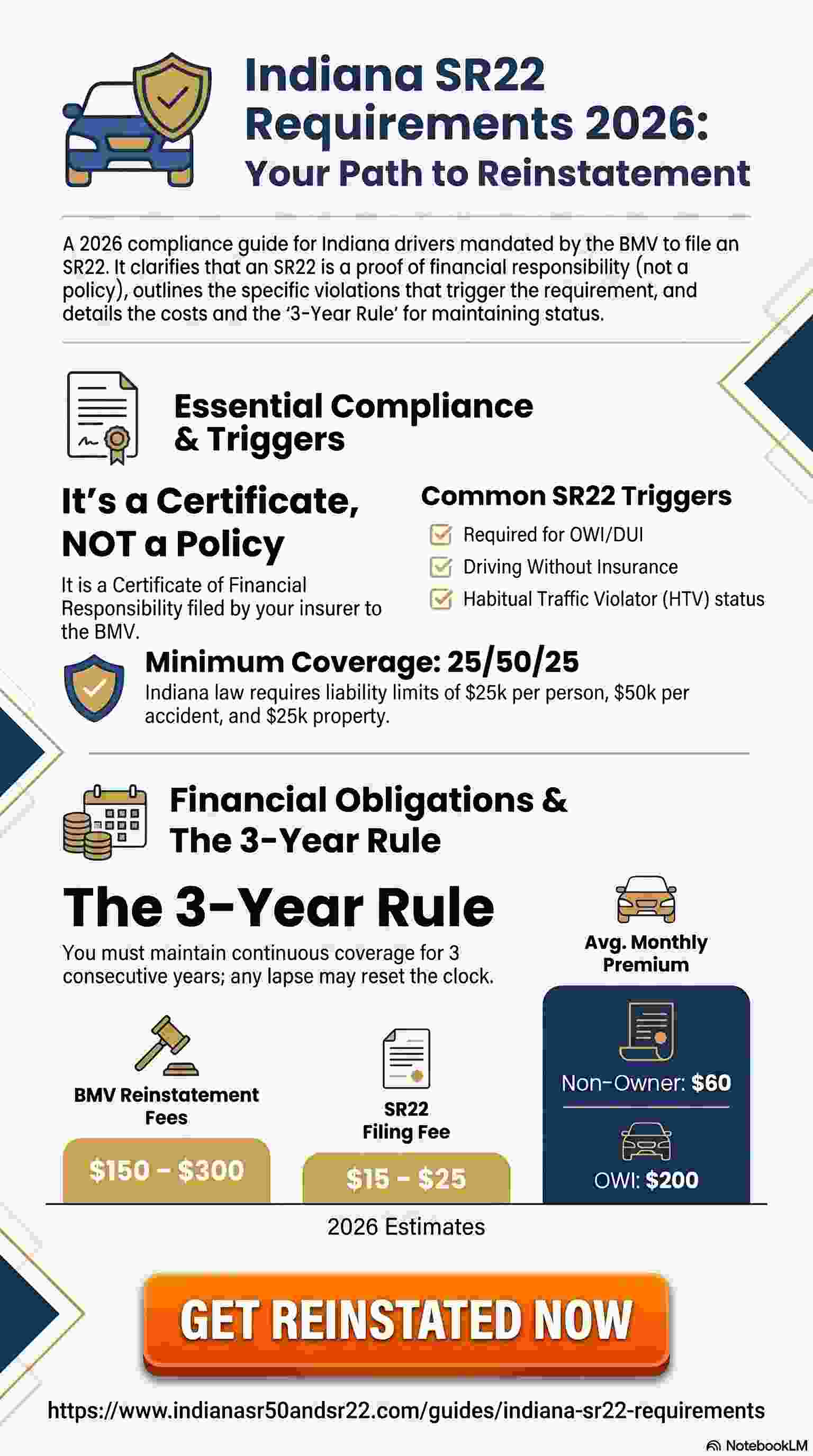
Indiana SR22 at a Glance: This infographic summarizes 2026 BMV requirements.
Click to expand +What Is the Indiana BMV SR22 Requirement?
An SR22 is not an insurance policy itself, despite the common misconception. It is a Certificate of Financial Responsibility — a legally binding document your insurance provider files directly with the Indiana BMV on your behalf, guaranteeing that you carry at least the state-mandated minimum liability insurance.
When the state tells you that you are subject to Indiana SR22 requirements, they are saying you have been flagged as a high-risk driver. The BMV no longer trusts you to simply promise that you have auto insurance. They require continuous, verifiable proof directly from your insurance provider — and if that coverage ever lapses, your insurer must report it to the BMV immediately via an SR26 cancellation form, triggering an automatic suspension of your driving privileges.
SR22 is a Certificate, Not a Policy
The SR22 is an official addendum attached to an underlying auto insurance policy. When you set up car insurance with an SR22 in Indiana, your insurer files this document to tell the BMV: “We guarantee this driver carries at least the state-mandated minimum liability insurance. If they ever cancel their policy, miss a payment, or allow coverage to lapse, we will notify the BMV immediately.”
Because of this monitoring obligation, insurers take on added administrative burden and higher perceived risk — which is why SR22 filings are handled by specialized high-risk carriers.
Which Violations Trigger an SR22 Requirement in Indiana?
The Indiana BMV reserves this requirement for serious moving violations or repeat offenses that indicate a driver poses a financial or physical risk to other motorists.
- Operating While Intoxicated (OWI / DUI): A conviction for an OWI will almost automatically result in a court-ordered or BMV-mandated SR22 requirement before your driving privileges can be reinstated. This is the most common — and most costly — trigger.
- Driving Without Insurance: If you are caught driving uninsured — whether pulled over or involved in an accident — the BMV will require an SR22 to prove you have rectified the situation.
- Habitual Traffic Violator (HTV) Status: If you accumulate too many points within a specific timeframe, the BMV will label you a Habitual Traffic Violator. Regaining your license after an HTV suspension always requires an SR22.
- Reckless Driving or Severe At-Fault Accidents: Causing an accident that results in severe injury, death, or massive property damage can prompt the BMV to demand an SR22 upon reinstatement.
- Failure to Pay BMV Judgments: If you are sued for an accident while uninsured and fail to satisfy the civil judgment, your license will be suspended. Reinstatement requires clearing the judgment and filing an SR22.
- Failure to Pay Child Support: In some cases, failing to pay court-ordered child support can result in a license suspension where reinstatement requires demonstrating financial responsibility through an SR22.
SR22 is also commonly required after accumulating too many points on your license, which triggers an automatic BMV suspension once you cross 20 points.
Expert Tip: Every SR22 requirement is tied to a specific offense on your driving record. You must maintain this filing until the penalty period associated with that exact offense expires — the BMV does not negotiate.
How the Indiana BMV Notifies You
When a conviction is processed and reported to the Indiana BMV, or when you fail to provide proof of insurance after an accident, the BMV generates a Notice of Suspension sent via US Mail to the address they have on file.
- Address problem: You must update your address with the BMV within 30 days of moving. The BMV considers the notice delivered regardless of whether you actually received it.
- What the notice contains: The reason for suspension, the dates, reinstatement fees owed, and whether an SR22 is required.
- Don't wait for the letter: Check your status proactively at the official Indiana BMV website (myBMV).
Indiana SR22 Form — What It Is and How It Gets Filed
Who Files the SR22 Form — Not You
One of the most frequent mistakes drivers make is trying to download an SR22 form, fill it out themselves, and mail it to the BMV. You cannot file your own SR22.
Only an auto insurance provider licensed to do business in Indiana can file the SR22 certificate. The process:
- Contact a high-risk auto insurance provider.
- Request a policy with an SR22 filing.
- Pay your premium and the SR22 filing fee ($15–$25).
- The insurance company generates the form and submits it electronically to the BMV via the Electronic Data Interchange (EDI) system.
How Long Does the BMV Take to Process?
- Electronic filing (standard): 24 to 72 hours (1–3 business days).
- Paper/mail filing (slow): 10 to 15 business days. Avoid this.
Critical warning: Do not assume your license is valid because you paid for insurance. Your suspension is not lifted until the BMV receives the form, processes it, and officially updates your driving record to “Valid.”
How to Check Your SR22 Status With the Indiana BMV
- Go to the official Indiana BMV portal (myBMV).
- Log in with your driver's license number, social security number, and zip code.
- Navigate to “Driver Record” or “Reinstatement Requirements.”
- Find the “Insurance/Financial Responsibility” section.
- Look for “On File” (active) or “Required / Pending” (not yet received).
If more than 5 business days have passed since electronic filing and it still shows pending, call your insurance agent immediately and ask for the submission date and confirmation number.
How Long Are You Required to Maintain SR22 in Indiana?
The 3-Year Rule — When Does the Clock Start?
Under standard Indiana SR22 laws, you must maintain continuous financial responsibility for three (3) consecutive years. For Habitual Traffic Violators or severe repeat offenses, courts or the BMV may extend this to five (5) years.
Critical: The 3-year clock does NOT start on the date you were pulled over or convicted. In Indiana, it officially begins on the date your driver's license is formally reinstated by the BMV. See the full timeline breakdown: How Long Does SR22 Last in Indiana?
What Happens If Your Policy Lapses
A lapse can occur because:
- You missed a monthly premium payment.
- Your credit card on file expired and auto-pay failed.
- You cancelled your policy to switch carriers, but the new policy did not start on the exact same day.
- The insurance company dropped you due to further driving infractions.
When a lapse occurs:
- Immediate suspension: Your insurer files an SR26. The moment the BMV receives it, your driving privileges are suspended.
- New reinstatement fee: You owe a new BMV fee of $150–$300.
- The clock can reset: Depending on your case, a lapse may cause your 3-year requirement to restart from day one — even if you were 30 days from finishing.
How to safely switch companies: Buy the new policy first. Confirm the new SR22 is on file at myBMV. Only then cancel your old policy.
Can You Get SR22 Removed Early?
No. The Indiana BMV does not negotiate duration. There is no good behavior discount. The only exception is if your underlying conviction is overturned by a higher court. Once your 3-year period is complete, confirm the change on myBMV before cancelling the SR22 endorsement.
SR22 Minimum Coverage Requirements in Indiana
Indiana's Mandatory Liability Limits: 25/50/25
- $25,000 Bodily Injury per Person: Maximum payout to a single individual you injure in a crash.
- $50,000 Bodily Injury per Accident: Maximum total payout for all individuals injured in a single crash.
- $25,000 Property Damage:Covers repair or replacement of the other driver's vehicle and any other property you damage.
SR22 With a Financed Vehicle — Special Rules
While the Indiana BMV only requires liability coverage (25/50/25), your auto lender requires full coverage to protect their asset: liability + collision + comprehensive.
Rule of Thumb: If you have a car payment, you must purchase full coverage and attach the SR22 to that specific policy. Some drivers opt to sell the financed vehicle, buy a cheap used car in cash, and run minimum-liability SR22 until the 3-year requirement ends.
How Much Does SR22 Insurance Cost in Indiana?
The SR22 Filing Fee (One-Time)
The filing fee is a one-time administrative charge your insurance company adds to process and submit the certificate to the Indiana BMV. It typically ranges from $15 to $25 and is paid directly to your carrier at policy purchase. It is not recurring.
Average SR22 Premiums in Indiana by Violation Type (2026)
| Offense / Situation | Est. Monthly Premium | Annual Cost | Severity |
|---|---|---|---|
| OWI / DUI (first offense) | $150 – $200 | $1,800 – $2,400/yr | Maximum |
| Habitual Traffic Violator (HTV) | $100 – $180 | $1,200 – $2,160/yr | Maximum |
| Reckless driving / at-fault accident | $110 – $170 | $1,320 – $2,040/yr | High |
| Driving without insurance | $90 – $130 | $1,080 – $1,560/yr | Moderate |
| Non-owner SR22 (no vehicle owned) | $60 – $100 | $720 – $1,200/yr | Lowest |
*Estimates based on Indiana market averages for minimum liability coverage. Rates vary by age, zip code, driving record, and carrier. See our Indiana SR22 Rate Comparison for a full carrier-by-carrier breakdown.
Indiana BMV Reinstatement Fees 2026
| Offense Count | BMV Reinstatement Fee | How to Pay |
|---|---|---|
| First offense | $150 | myBMV portal, mail, or in-person |
| Second offense | $225 | myBMV portal, mail, or in-person |
| Third or subsequent offense | $300 | myBMV portal, mail, or in-person |
Use our Indiana license reinstatement calculator to estimate your total cost. To find the cheapest carriers, see: Cheapest SR22 Insurance in Indiana and Best SR22 Insurance Companies in Indiana.
Do You Need SR22 in Indiana If You Don't Own a Car?
Yes — the SR22 obligation is tied to your driver's license, not to a specific vehicle. If the Indiana BMV has mandated an SR22 for your license reinstatement, owning or not owning a car is irrelevant to that obligation. What changes is the type of SR22 policy you need.
What Is a Non-Owner SR22 in Indiana?
A Non-Owner SR22 Indiana policy provides liability coverage for drivers who operate vehicles they do not own — borrowed cars, rental cars, or vehicles belonging to friends or family. Instead of being tied to a specific VIN, the policy is attached to you as the named insured driver.
- Who qualifies: Any driver with an Indiana SR22 mandate who does not own a registered vehicle.
- Coverage minimum: Same 25/50/25 liability limits — satisfies the BMV requirement.
- Cost: Non-owner SR22 policies are typically 30–50% cheaper than standard SR22 policies, averaging $60–$100/month.
- Duration: Same 3-year continuous filing requirement.
- Important limitation: Does not cover vehicles owned by members of your household — those require a standard policy.
Watch out: If you later purchase a vehicle during your 3-year SR22 period, you must immediately switch from a non-owner policy to a standard SR22 policy listing that vehicle. Failing to do so creates a coverage gap.
For a complete breakdown, including carrier options and quotes: Non-Owner SR22 Insurance Indiana — Full Guide.
SR50 vs. SR22 — Indiana's Two Forms Explained
While the SR22 is used nationwide (with minor state variations), the SR50 is unique to Indiana. Understanding the distinction is vital — submitting the wrong form results in a rejected reinstatement and continued license suspension.
- The SR22 is about the FUTURE. It is a continuous Certificate of Financial Responsibility. It proves you have insurance right now and guarantees you will keep it for 3 years. It is ongoing monitoring.
- The SR50 is about the PAST.Officially the “Affidavit of Current Insurance,” it is a one-time proof that you had active minimum liability insurance on a specific past date — usually the date of a traffic stop or accident. Once filed, the obligation is met with no ongoing requirement.
When You Need SR50 vs When You Need SR22
You will typically need an SR50 if:
- You are randomly selected by the BMV's electronic insurance verification system to prove you have active insurance.
- You receive a minor traffic ticket and the BMV requires proof you were insured on the date the citation was issued.
- You were involved in a minor accident and the state needs verification that your vehicle was covered at the time.
You will strictly need an SR22 if:
- You are convicted of an OWI.
- You were caught driving while your license was already suspended.
- You are obtaining a specialized driving privilege (hardship license) to drive to work during a suspension.
- You are reinstating your license after a major suspension dictated by a judge or the BMV.
When You Need Both SR22 and SR50 at the Same Time
In some complex situations, the Indiana BMV may require both. This typically happens in a compounded violation scenario — for example, you are pulled over for speeding, and the officer discovers you are driving on a suspended license and have no insurance.
To clear the original suspension, the BMV might demand an SR50 to confirm the previous insurance compliance failure. Simultaneously, because you were caught driving on a suspended license, the court triggers an administrative penalty requiring an SR22 going forward. In these cases, you must coordinate with an insurer that understands Indiana's EDI system to submit both forms correctly.
For a completely comprehensive breakdown of how these forms interact: SR22 & SR50 Forms — Deep Dive.
Why Indiana Has SR50 When Other States Don't
If you discuss your situation on national online forums, you might find no one outside Indiana has ever heard of an SR50. This is because the requirement for SR50 insurance Indiana was born out of the state's aggressive stance on uninsured motorists.
Unlike states that rely solely on police officers checking paper insurance cards during traffic stops, Indiana utilizes a sophisticated, centralized electronic database to monitor uninsured drivers. When a driver commits a moving violation or is involved in a crash, the BMV's automated system is triggered and requires your insurance company to electronically verify that coverage was active — not just a paper card you showed the officer.
The SR50 is the official digital handshake between your insurer and the BMV confirming that coverage existed on the specific date in question. It is submitted directly by the insurer via the Electronic Data Interchange (EDI) system, making it nearly impossible to fake insurance coverage in Indiana — eliminating the tactic where a driver buys a policy, prints the ID card, and cancels the next day.
This EDI-based verification is a key pillar of Indiana BMV regulations and a major reason Indiana's uninsured motorist rate is lower than many comparable states.
SR22 Requirements Across Indiana Cities
While the Indiana BMV enforces SR22 regulations uniformly at the state level, the reality of navigating a suspension feels very different depending on where you live.
Indianapolis (Marion County)
As the state's largest metropolitan area, Indianapolis processes the highest volume of SR22 filings. Drivers in Marion County often deal with highly congested traffic courts, meaning administrative delays are common. If you are convicted of an OWI in Indianapolis, you will likely be dealing with Marion County Superior Courts, which are notoriously strict regarding specialized driving privileges. The IndyGo transit system is one of the few public options in the state — a viable stopgap while you save for reinstatement costs.
Fort Wayne (Allen County)
Fort Wayne courts are highly aggressive regarding repeat offenders and Habitual Traffic Violators. Allen County drivers frequently find themselves mandated to carry SR22 for 5-year probationary periods rather than the standard 3 years, depending on the judge presiding. Because Fort Wayne is heavily auto-dependent, particularly in suburban areas, securing SR22 insurance in Fort Wayne quickly is usually a top priority for residents who need to commute.
Evansville (Vanderburgh County)
Evansville's proximity to the Kentucky and Illinois borders creates unique complications. If you live in Evansville with an Indiana SR22 and are regularly crossing state lines, your Indiana SR22 remains valid provided your underlying policy covers out-of-state travel. If you move across the border, you must maintain your Indiana SR22 filing from an insurer licensed in both states until your 3-year requirement ends. See: SR22 Insurance in Evansville.
South Bend, Bloomington & Gary
For drivers in smaller Indiana cities, the SR22 process is identical to Indianapolis at the BMV level — but local court systems and available public transit options vary significantly. Drivers in these areas often struggle more with the cost burden since wages are lower and public transit is sparse. Seeking out the cheapest SR22 insurance carriers in Indiana is especially critical in these markets.
Indiana SR22 Requirements — Frequently Asked Questions
How do I know if I need an SR22 in Indiana?
The Indiana BMV sends a Notice of Suspension to your registered address. You can also check your status 24/7 at the myBMV portal. If you were convicted of an OWI, driving without insurance, or designated a Habitual Traffic Violator, an SR22 is almost always required before reinstatement.
What happens if I don't get SR22 in Indiana?
Driving without reinstating through the SR22 process means driving on a suspended license — a Class A misdemeanor in Indiana punishable by up to 1 year in jail and fines up to $5,000. To fix this, you must secure an SR22 with a suspended license in Indiana before getting behind the wheel. Your vehicle may also be impounded if you are caught. The longer you delay, the more reinstatement fees accumulate.
Can I get SR22 the same day in Indiana?
Yes. Most major high-risk insurers (Progressive, The General, Dairyland, National General) can issue your policy and file electronically within hours. The BMV processes within 24–72 business hours. Same-day filing is available, but license reinstatement requires BMV confirmation — typically 1–3 business days after submission.
Does Indiana SR22 transfer if I move to another state?
Your obligation to Indiana does not end if you move. Under the Interstate Driver's License Compact, Indiana will communicate your suspended status to your new state, which may refuse to issue you a license. You must obtain an insurance policy in your new state from a carrier licensed in both states and request an “Out-of-State SR22 filing” with the Indiana BMV.
What is Indiana's reinstatement fee after an SR22 lapse?
Indiana BMV reinstatement fees are tiered: $150 first offense, $225 second offense, $300 third or subsequent. This is separate from your insurance premium and SR22 filing fee.
Can I use an out-of-state insurer for Indiana SR22?
Only if the insurer is licensed and authorized by the Indiana Department of Insurance to file with the Indiana BMV. Always confirm upfront: “Are you authorized to file an SR22 electronically with the Indiana BMV?” Major nationals like Progressive, GEICO, and The General are authorized. Many small regional carriers are not.
Can I file the SR22 myself?
No. The Indiana BMV does not accept SR22 forms directly from private citizens. Any attempt to submit paper documents yourself will result in a rejected reinstatement and potential fraud charges.
Can I switch insurance companies while under SR22?
Yes, but carefully. Buy the new policy first. Confirm the new SR22 is on file at myBMV. Only then cancel your old policy. Even one day of lapse between carriers can trigger a suspension and reset your 3-year clock.
Does SR22 affect my credit score?
No. The SR22 filing itself is not reported to credit bureaus. However, if you allow your SR22 policy to lapse due to non-payment and the debt goes to collections, that collection account can negatively affect your credit.
Where can I get SR22 insurance near me in Indiana?
You don't actually need a local insurance office. Every SR22 in Indiana is filed electronically (EDI) directly between the insurer and the BMV, so proximity to an agent doesn't affect how fast — or whether — your filing goes through. What matters is picking a carrier authorized to file with the Indiana BMV. Rates do vary somewhat by city due to local risk pools; see our guides for Indianapolis, Fort Wayne, Evansville, and other Indiana cities for local average rates.
Who needs SR22 insurance in Indiana?
You need an SR22 if you fall into one of four groups: convicted of an OWI/DUI, caught driving without insurance, designated a Habitual Traffic Violator, or ordered by a court following an at-fault accident where you had no coverage. If none of these describe you, you don't need one — Indiana never requires SR22 as a routine part of getting or renewing a license.
What is a Certificate of Compliance (COC), and how is it different from an SR22?
A Certificate of Compliance (COC) is the form your insurer files to prove you were covered on one specific past date — typically to clear a suspension tied to a single accident or citation. It is backward-looking and one-time. An SR22 is the opposite: it's forward-looking, certifying you'll maintain continuous coverage for the next 3 years. You'll generally only be asked for a COC if you can prove you were insured at the time in question; if you can't, the BMV requires an SR22 instead.
How do I check the status of my SR22?
Log into myBMV and check the “Insurance/Financial Responsibility” section of your driver record for “On File” (active) or “Required/Pending” (not yet received). See our full step-by-step walkthrough above for what to do if it's still pending after 5 business days.
Conclusion: Taking Control of Your Indiana SR22
Receiving an Indiana SR22 requirements notice is a frustrating roadblock, but it does not have to ruin your financial life or keep you off the road permanently. The system is rigid, but entirely predictable. Follow these five golden rules:
- Never let your policy lapse. Pay premiums a few days early and set up automatic payments.
- Do not attempt to file the form yourself. Rely on an authorized high-risk insurance agent.
- Keep your address updated with the BMV so you never miss a vital suspension notice.
- Monitor your myBMV accountto verify your 3-year clock is running and your SR22 shows “On File.”
- Never cancel your old SR22 policy before your new one is confirmed. Even one day of lapse can restart the entire clock.
Start by finding the cheapest SR22 insurance in Indiana, secure your 25/50/25 liability coverage, ensure your indiana SR22 form is filed electronically, and drive safely.
*Disclaimer: The information provided in this 2026 guide is intended for educational purposes and should not be construed as formal legal advice. Auto insurance laws and BMV administrative rules are subject to change. Always consult directly with a licensed Indiana insurance agent or legal professional regarding your specific driving history and license suspension.*
Read More
SR50 Insurance Guide 2026
Understand the Indiana SR50 form, when the BMV requires it, and how to get covered.
SR22 & SR50 Forms Explained
The difference between forms, how they are filed, and why you can't do it yourself.
What Is an SR26 in Indiana?
The SR26 cancellation form explained — what triggers it, what it does to your license, and how to fix it.
Non‑Owner SR22 Insurance
Don't own a car? Learn how to satisfy BMV requirements with a non-owner policy.
Know the Requirements for Reinstatement Now
Takes 2 minutes. No commitment.
Reinstatement Calculator — Free →