Indiana SR50 Insurance — What It Is, When You Need It, and How to Get It (2026)
Quick Answer
An SR50 in Indiana is an Affidavit of Current Insurance — a form your insurance company files electronically with the Indiana BMV proving you had active coverage on a specific past date. It is not a type of insurance policy you purchase. Indiana is one of the only states in the U.S. that uses this form.
If you have recently received a notice from the Indiana Bureau of Motor Vehicles (BMV) stating that you need to submit an SR50, you are likely experiencing a mixture of confusion and frustration. If you searched online for answers, you probably found endless articles talking about SR22s, leaving you wondering if you received the wrong letter or if your BMV notice contains a typo.
It isn't a typo. SR50 insurance Indiana requirements are completely unique to the Hoosier State. Because this is a state-exclusive form, national insurance websites often provide thin, inaccurate, or entirely incorrect information regarding what the SR50 form actually does.
In this comprehensive 2026 guide, we are going to break down everything you need to know about SR50 Indiana laws — exactly what the form is, the specific scenarios in which the Indiana BMV will demand one, the step-by-step process of acquiring it, and how much it costs.
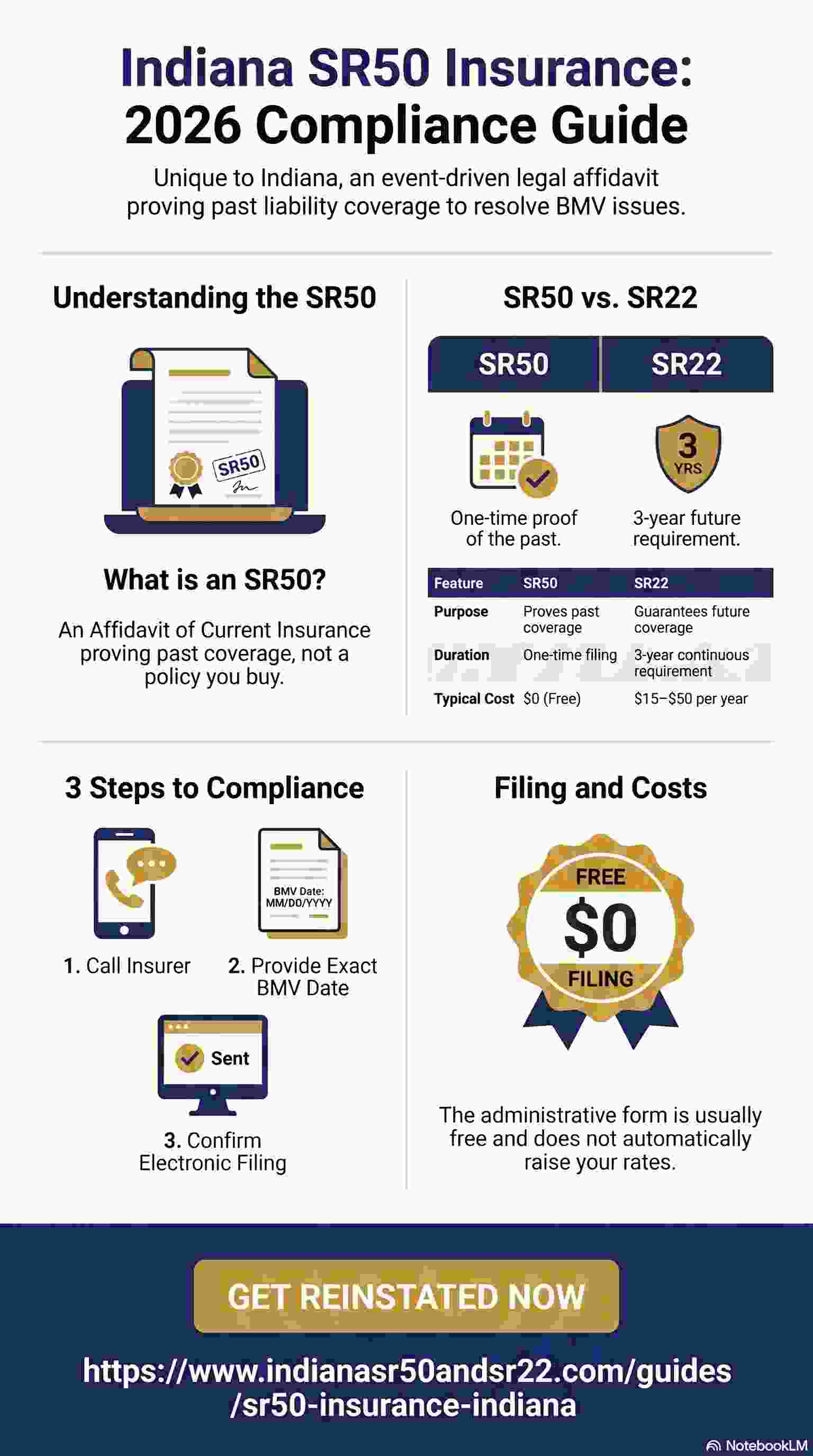
Indiana SR50 Guide: This infographic shows What SR50 Is, When You Need It and How to Get It
Click to expand +What Is SR50 Insurance in Indiana?
To understand what an SR50 is, we must first clear up a major misconception: SR50 is not an actual type of insurance.
You cannot buy an “SR50 insurance policy.” Instead, the SR50 is an official document — formally known as an Affidavit of Current Insurance — that your auto insurance company files electronically with the Indiana Bureau of Motor Vehicles.
The sole purpose of the SR50 is to prove to the BMV that you carried the state's minimum required liability auto insurance (25/50/25) on one specific date in the past.
The state of Indiana requires all drivers to carry financial responsibility. If you are involved in a traffic incident, a moving violation, or a random BMV audit, the state wants verifiable proof that you were legally insured at the exact moment that incident occurred. A standard insurance ID card is not enough for the BMV's compliance division; they require the legally binding Indiana SR50 form directly from your insurance carrier.
Why Indiana Uses SR50 When Most States Don't
Most states rely on a continuous, real-time database where insurance companies report policy cancellations immediately. If a policy lapses, the state automatically suspends the registration.
Indiana, however, relies heavily on an event-driven and randomized verification system. Rather than tracking every driver 24/7, the state targets specific triggers — such as traffic tickets, accidents, or point accumulations on your driving record. When one of these triggers occurs, the state requires sworn, legally binding proof from the insurance carrier that coverage was active. The SR50 acts as this sworn affidavit, cutting down on fraudulent paper insurance cards and ensuring the BMV receives data directly from licensed carriers.
What Does “SR-50” Actually Stand For?
SR stands for Safety Responsibility. The number 50 simply distinguishes this form from the SR22 and SR26 forms used in other contexts. All SR forms share the same purpose — proving financial responsibility — but they differ in timing and legal effect. Indiana uses both the SR22 and SR50 simultaneously, making it unique among U.S. states.
The Indiana SR50 Form — What It Actually Contains
While most SR50 filings today are done electronically between your insurance company's system and the BMV, the Indiana SR50 form contains several vital pieces of data. If even one digit is incorrect, the BMV will reject the filing.
- Driver Information:Your full legal name, date of birth, address, and Indiana Driver's License Number.
- Vehicle Information: The Make, Model, Year, and Vehicle Identification Number (VIN) of the car you were driving.
- Insurance Company Information: The name of the insurance carrier and their official NAIC code.
- Policy Number: The active policy number under which you were covered.
- The Verification Date: This is the most important field. The insurer is signing a legal document stating coverage was active on this exact day.
If you want to see exactly what this paperwork looks like, read our SR22 and SR50 Forms deep-dive.
SR50 vs SR22 — Key Differences Explained
The biggest source of confusion for Indiana drivers is the difference between an SR50 and an SR22. Here is the complete comparison:
| Feature | SR50 | SR22 |
|---|---|---|
| Purpose | Proves you had insurance on a past date | Proves you will maintain insurance going forward |
| Time Direction | Backward — proves past compliance | Forward — guarantees future compliance |
| How Long Required | One-time filing | 3 years (continuous) |
| When Required | After traffic stop, BMV audit, or coverage gap notice | After a license suspension (DUI, uninsured driving, points) |
| Who Files It | Your current insurance carrier | Your insurance carrier |
| Cost of the Form | Usually free ($0–$25 admin fee) | $15–$50/year added to your premium |
| Raises Your Rates? | No — the form itself does not | Yes — high-risk classification increases premium |
| States That Use It | Indiana only | All 50 states |
For a more detailed breakdown of both forms, visit our SR22 vs SR50 forms guide. If your compliance failure has already resulted in a loss of driving privileges, you will specifically need an SR22 with a suspended license in Indiana to legally drive again.
When Does the Indiana BMV Require an SR50?
The Indiana BMV does not ask for an SR50 without a reason. If you received a letter demanding this form, a specific event triggered the BMV's compliance system. Under Indiana law, the BMV is legally obligated to verify your financial responsibility when certain conditions are met.
Here are the most common scenarios that result in an SR50 demand.
Scenario 1 — Traffic Stop: You Had Insurance But Couldn't Prove It
This is the most common reason drivers search for SR50 insurance Indiana.
Imagine you are driving down I-65 and get pulled over for a broken taillight or speeding. The officer asks for proof of insurance. You know you pay your premium every month, but you can't find your card, your phone died, or you forgot to update your glovebox.
The officer may write a citation for “Failure to Provide Proof of Financial Responsibility.” When that ticket is processed and forwarded to the BMV, the state's system automatically flags your profile. The BMV then sends you a letter stating: “Please submit an SR50 proving you had insurance on [that specific date].”
In this scenario, obtaining the SR50 is straightforward because you actually did have insurance on that date. (If you were driving a borrowed vehicle and don't own a car, you will need your provider to verify a non-owner SR50 insurance Indiana policy).
Scenario 2 — BMV Audit: A Coverage Gap Was Detected
Indiana uses a “Previous Insurer Notification” system. If your policy is canceled, your insurer must notify the BMV. If no new policy notification arrives within a set timeframe, the BMV initiates a randomized audit and mails you a Notice of Insurance Verification — requiring an SR50 for a specific past date to confirm you weren't driving uninsured.
Additionally, Indiana mandates that anyone involved in an accident resulting in a police report must verify insurance via an SR50, regardless of fault.
Scenario 3 — You Need Both SR50 and SR22 at the Same Time
This is the worst-case scenario, as the penalties for driving without insurance in Indiana are severe. If you were pulled over and actually did not have insurance on that date, you cannot provide the SR50. The BMV then suspends your license for a minimum of 90 days. To reinstate it, you must purchase new coverage and file an SR22 (proof of future insurance) for 3 years. Even if the car you were driving belonged to someone else, you must file a non-owner SR22 to satisfy the state.
So the SR50 demand was the test — failing to produce it triggers the SR22 requirement. Both forms apply simultaneously to different parts of the same incident.
How to Get SR50 Insurance Filed in Indiana (3 Steps)
If you have received a demand for an SR50, time is critical. The BMV letter will state a deadline — miss it and your driving privileges are suspended automatically.
Contact Your Insurance Carrier
Call the insurer that held your policy on the specific date in question. Ask them to file an SR50 Affidavit of Current Insurance with the Indiana BMV.
Expert tip: If the rep sounds confused, say: “I need an Affidavit of Current Insurance submitted electronically to the Indiana BMV for a past verification date.” This bypasses frontline confusion at large national carriers.
Provide the Exact Verification Date
Give your insurer the exact date shown on your BMV notice. Do not approximate. If the BMV requests proof for March 14th, the SR50 must be filed for March 14th. An SR50 filed for March 15th will be automatically rejected, and your license will be suspended.
Your Insurer Files Electronically With the BMV
Your carrier transmits the SR50 through the BMV's secure electronic portal (standard practice in 2026). The BMV updates your record within 24–48 business hours. Always request a confirmation number or email receipt.
What if You Didn't Have Insurance on That Date?
If you were genuinely uninsured on the verification date, you cannot get an SR50. It is illegal for an insurance company to backdate a policy. Your license will be suspended. Your next steps shift to license reinstatement: serve the suspension, pay BMV reinstatement fees ($250–$1,000 depending on prior offenses — though you may qualify for an Indiana license reinstatement fee waiver), and file an SR22 to get your license back.
How Much Does SR50 Insurance Cost in Indiana?
Cheap SR50 Insurance Indiana: Why the Cost Is Almost Always $0
When drivers search for cheap SR50 insurance Indiana, they often fear a steep ongoing premium. The reality is much simpler — because the SR50 is just a form proving past behavior, the cost is almost nothing.
SR50 Filing Fee
How much does the SR50 cost? In most cases, $0.
Most major insurance carriers process and submit an SR50 to the Indiana BMV entirely free of charge. Some smaller, non-standard agencies may charge a one-time administrative fee of $15 to $25. An SR50 does not automatically raise your insurance rates — the form itself is administrative paperwork.
However, the reasonyou had to file the SR50 might raise your rates. A speeding conviction will appear on your driving record and increase your premium — but that is the ticket's fault, not the SR50's.
SR50 vs SR22 Cost Comparison
| Cost Item | SR50 | SR22 |
|---|---|---|
| Filing fee | $0 (most carriers) | $15–$50/year (added to premium) |
| Effect on monthly premium | None from the form itself | Increases due to high-risk classification |
| Duration of added cost | One-time | 3 years |
| Indiana urban vs rural difference | Your underlying auto insurance premium (which determines SR50 eligibility) varies significantly by ZIP code. Marion County drivers pay more than rural Indiana drivers due to traffic density and uninsured motorist rates. | |
Finding Cheap SR50 Insurance Providers in Indiana
If your insurer dropped you after an incident, look for carriers that specialize in non-standard auto insurance:
- Compare at least 3 quotes before committing. Rates vary dramatically between carriers for the same driver profile.
- Use non-standard specialists — The General, Dairyland, and Bristol West deal with Indiana BMV compliance paperwork routinely and won't be confused by your SR50 request.
- Bundle if possible — adding renters or homeowners insurance often unlocks a 5–15% multi-policy discount.
SR50 in Indianapolis — Local Guide
If you live in Central Indiana, the search for SR50 insurance Indianapolis brings unique challenges. Marion County is heavily populated, trafficked, and policed. The interstates that loop the city (I-465) and cut through it (I-65 and I-70) are hotspots for the exact traffic stops that trigger SR50 demands.
Indianapolis has a higher-than-average rate of uninsured motorists relative to the rest of Indiana. Because of this, Marion County traffic courts, the IMPD, and the Indiana State Police aggressively enforce financial responsibility laws.
If you are pulled over in Indianapolis without proof of insurance, the local courts push that data to BMV headquarters — which is also located downtown at the Indiana Government Center — faster than in rural counties. Expect your SR50 demand letter sooner.
For hyper-local advice on Marion County insurance agencies experienced with BMV compliance paperwork, read our SR22 and SR50 Indianapolis guide.
Indiana SR50 FAQ — 10 Questions Answered
Here are the most frequently asked questions about the Indiana SR50 form and state insurance compliance.
What is an SR50 in Indiana?
An SR50 is an Affidavit of Current Insurance — a form your auto insurance company files electronically with the Indiana BMV to prove you had active coverage on a specific past date. It is not a policy you buy. Indiana is one of the only states that uses this form.
What does SR-50 mean?
SR stands for Safety Responsibility. The number 50 distinguishes it from the SR22 (used nationally) and the SR26 (cancellation notice). The SR50 is Indiana's specific form for verifying past insurance coverage and is not used in any other state.
What is a SR50 insurance form exactly?
It is a legal affidavit submitted by a licensed Indiana insurance carrier to the BMV, confirming your policy was active on a specific date. It includes your driver's license number, vehicle VIN, policy number, the insurer's NAIC code, and the exact verification date. One incorrect detail causes automatic rejection.
What's the difference between an SR-22 and an SR50?
The SR50 proves you had insurance on a past date (one-time filing). The SR22 proves you will maintain insurance for the next 3 years (ongoing requirement after a suspension). You can need both simultaneously if you were uninsured at the time of a stop — the SR50 for the past date, the SR22 for the reinstatement going forward. (Note: If you do not own a vehicle but are subject to the ongoing requirement, you must purchase non-owner SR22 insurance Indiana).
How much does SR50 insurance cost in Indiana?
The SR50 form itself is free at most major carriers. Some smaller agencies charge a one-time fee of $15–$25. The SR50 does not raise your insurance premium — only the underlying violation (ticket, accident) affects your rates.
Where can I find cheap SR50 insurance in Indiana?
You do not need a special “SR50 insurance” product — your existing or new auto carrier files the form at little to no cost. Compare at least three quotes, favor non-standard insurers like The General, Dairyland, or Bristol West if you have a recent violation on file, and confirm electronic SR50 filing is included free before switching policies.
How long does an SR50 take to process with the Indiana BMV?
Electronic filings (standard in 2026) are transmitted instantly, but the BMV takes 24 to 48 business hours to update your driver record. Physical mail takes 10 to 14 business days. Always choose electronic — and get a confirmation receipt from your insurer.
Can I file an SR50 myself without an insurance company?
No. The SR50 must be filed by a licensed Indiana carrier. The BMV will not accept a personal letter, bank statement, or printed insurance card as a substitute. It must be a legally sworn affidavit from an authorized insurance representative.
What happens if I didn't have insurance on the BMV's verification date?
Your license will be suspended for a minimum of 90 days (up to a year for repeat offenses). You cannot backdate a policy. After the suspension, you must pay reinstatement fees ($250–$1,000) and file an SR22 to legally drive again.
Does an SR50 appear on my Indiana driving record?
The SR50 itself is not a negative mark — it shows compliance. However, the underlying violation (ticket, accident, citation) will appear on your Official Driver Record (ODR) and may add points to your license, potentially raising your insurance premium.
Conclusion
Dealing with the Indiana Bureau of Motor Vehicles is stressful, especially when acronyms like SR50 are thrown around without clear explanations.
Remember the golden rule: The SR50 is simply a document proving you had insurance on a specific date in the past. If you were properly insured on the date in question, satisfying this requirement is a quick phone call to your insurer. Act fast, use the exact verification date from your BMV notice, and request electronic filing with a confirmation receipt.
If you also need an SR22 to reinstate a suspended license, see our Indiana SR22 requirements guide for the full reinstatement process. Unsure what you owe the BMV? Use our free Indiana license reinstatement calculator to estimate your costs instantly.
Read More
Indiana SR22 Requirements 2026
Everything you need to know about BMV SR22 requirements and reinstatement.
Points on License Indiana
BMV point values, suspension thresholds, and how points connect to your SR22 requirement.
SR22 & SR50 Forms Explained
The difference between forms, how they are filed, and why you can't do it yourself.
What Is an SR26 in Indiana?
The SR26 cancellation form explained — what triggers it, what it does to your license, and how to fix it.
Know the Requirements for Reinstatement Now
Takes 2 minutes. No commitment.
Reinstatement Calculator — Free →Finished reading?
Head back to our main page to explore more guides, tools, and resources for your license reinstatement.
← Back to Indiana SR22 & SR50 requirements