Indiana SR22 Form & SR50 Form — What They Are and How They Actually Get Filed
If you have recently opened your mail to find a suspension notice from the Indiana Bureau of Motor Vehicles (BMV), you are likely feeling a mix of confusion, frustration, and urgency. The letter probably states that your driving privileges are suspended—or are about to be—unless you submit an indiana sr22 form or an indiana sr 50 form.
For most drivers, this leads to an immediate scramble. You might be frantically searching online, wondering, "Where can I print this form? How do I fill it out? Where do I mail it?"
Take a deep breath. The most important thing you need to know right now is this: You do not fill out these forms yourself.
Despite being called "forms," both the SR22 and the SR50 are official legal certificates that can only be generated, verified, and submitted by an auto insurance company licensed to operate in the state of Indiana. You cannot download a blank form sr22 indiana requires, fill it in with a pen, and hand it to a clerk at your local BMV branch. Attempting to do so will only delay your license reinstatement.
In this comprehensive guide, we are going to demystify the paperwork. We will explain exactly what the sr22 form indiana drivers need actually is, how it differs from the SR50 form, and how these forms fit into the broader set of Indiana SR22 requirements the BMV enforces. We will also cover what information is transmitted to the state, and the step-by-step process of how these forms actually get filed with the sr22 indiana bmv system. By the end of this article, you will know exactly what steps to take to get you back on the road legally.
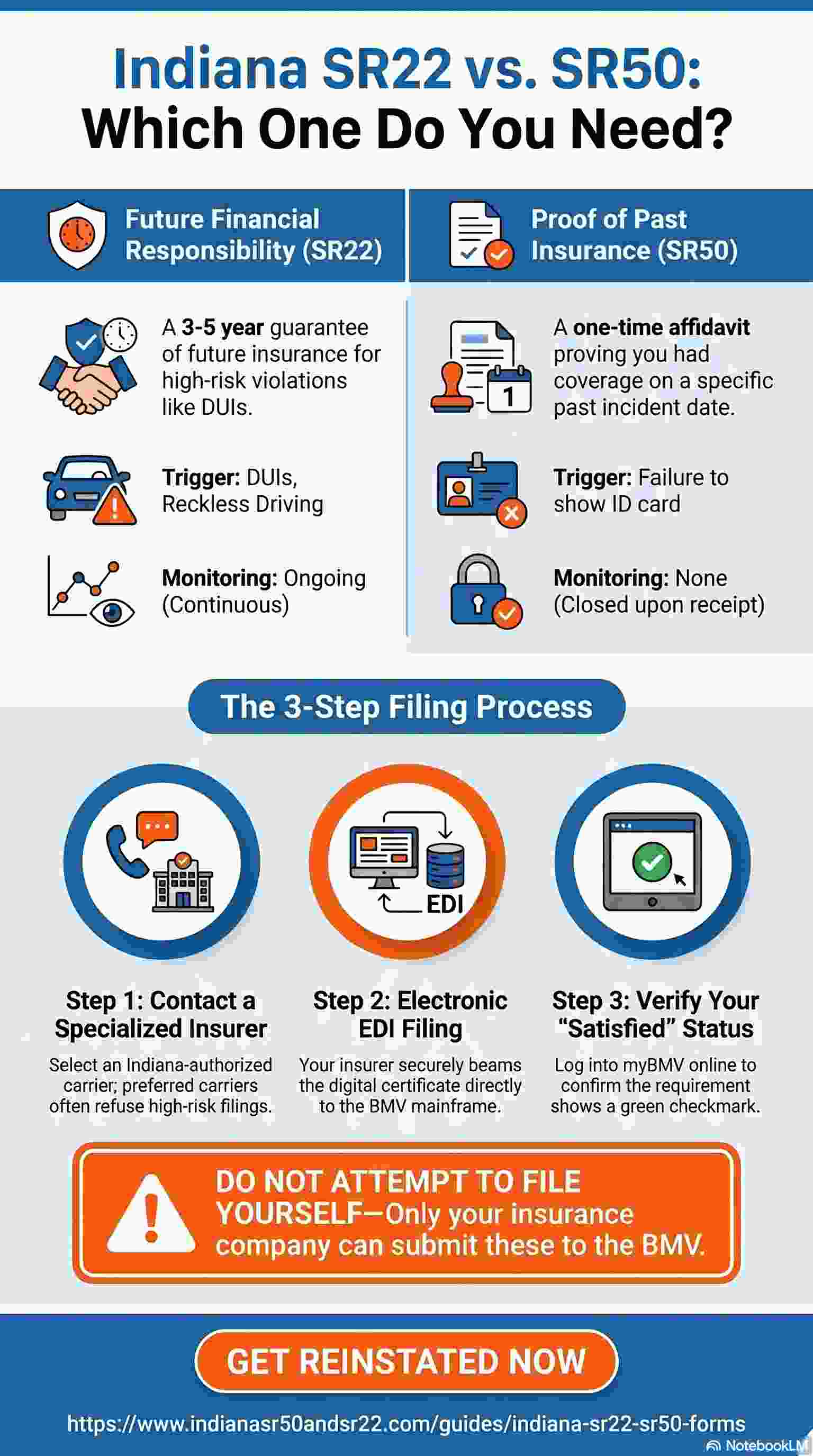
Indiana SR22 and SR50 at a Glance: This infographic compares both forms.
Click to expand +What Is the Indiana SR22 Form?
When dealing with a license suspension, the first piece of the puzzle is understanding the paperwork the state is demanding. The indiana sr22 form is frequently misunderstood. Often referred to as "SR22 insurance," the SR22 is not actually an insurance policy at all.
Instead, the SR22 is a Certificate of Future Financial Responsibility.
When the state of Indiana suspends your driver's license for a severe traffic violation—such as driving under the influence (DUI/OWI), driving without insurance, or accumulating too many points on your license—they mark you as a "high-risk" driver. Because you have proven to be a risk on the road, the state will not let you have your driver's license back until they have an ironclad guarantee that you carry the minimum required liability auto insurance.
The SR22 form is that guarantee. It is a legally binding document that your auto insurance carrier sends to the Indiana BMV. By filing this form, your insurance company is making a promise to the state of Indiana: "We insure this driver, they meet the state's minimum liability requirements, and if they cancel their policy or miss a payment, we will notify you immediately."
Is SR22 a Form You Fill Out or a Certificate Your Insurer Files?
This is the number one point of confusion for Indiana drivers, and understanding it will save you hours of frustration. The SR22 is a certificate your insurer files, not a form you fill out.
When you receive a letter from the BMV asking for an SR22, the state is essentially telling you to hire an insurance company to vouch for you. The BMV will not accept an SR22 document handed to them by a consumer. The document must come directly from the underwriting department of an authorized insurance provider.
Why does the state do it this way? It comes down to fraud prevention. In the past, drivers would buy insurance, print out their insurance card, show it to the BMV to get their license back, and then cancel the insurance policy the very next day. To close this loophole, the state created the SR22 system. Because the form is filed electronically from the insurance company's headquarters directly to the BMV's database, there is no way for a driver to forge the document or fake their coverage.
Furthermore, the form sr22 indiana mandates carries an ongoing obligation. The insurance company is legally required to monitor your policy. If your policy lapses for even a single day, the insurer automatically files an SR26 form Indiana drivers know all too well—which instantly alerts the BMV to suspend your license again.
What Information Appears on the Indiana SR22 Form
Because you won't be filling out the form yourself, you might be curious as to what exactly your insurance company is sending to the government on your behalf. The indiana sr22 formcontains highly specific, standardized data points that allow the BMV's automated system to link your insurance policy directly to your driving record.
When your insurer files the SR22, the document includes the following critical information:
- Your Personal Information: Your full legal name, date of birth, and current mailing address. This must match your BMV records exactly.
- Your Indiana Driver's License Number: This is the primary identifier used to attach the certificate to your suspended profile.
- The Insurance Carrier's Information: The name of the insurance company, their corporate contact information, and their NAIC (National Association of Insurance Commissioners) code to prove they are authorized in Indiana.
- Your Auto Insurance Policy Number: The exact policy number that provides your coverage.
- Effective and Expiration Dates: The date the policy begins and the date the current term ends.
- The SR22 Effective Date: The specific date the SR22 monitoring begins.
- Vehicle Information (If Applicable): If you own a car, the form will include the Vehicle Identification Number (VIN), make, and model of the insured vehicle. If you do not own a car, the form will indicate that it is a "Broad Form" or "Non-Owner" policy.
Where Does the SR22 Form Go? (Answer: Directly to the Indiana BMV)
Once your insurance company compiles all this data, where does it go? The completed sr22 form indiana auto insurers generate goes directly to the Indiana Bureau of Motor Vehicles (BMV) headquarters in Indianapolis.
More specifically, it is routed to the BMV's specialized financial responsibility division. Historically, these forms were physically mailed or faxed to the BMV. Today, the sr22 indiana bmvprocess is entirely digital. Approved insurance companies utilize a secure, encrypted Electronic Data Interchange (EDI) system to transmit the certificate directly into the BMV's mainframe.
This means that when you pay for your SR22 policy, the insurance company presses a button, and the certificate is securely beamed to the BMV. No physical paper changes hands, no envelopes are licked, and the risk of the form getting "lost in the mail" is virtually eliminated.
What Is the Indiana SR50 Form?
While the SR22 is widely known across the United States, the indiana sr 50 form is unique to the Hoosier state. If your BMV notice asks for an SR50, you are dealing with a completely different requirement. For a deep dive into the certificate itself, our guide to SR50 insurance Indiana covers every nuance of the affidavit process.
The SR50 is an Affidavit of Current Insurance.
Unlike the SR22, which is about proving you will have insurance in the future, the SR50 is about proving you had insurance in the past (specifically, on a precise date when an incident occurred).
The most common reason a driver needs an SR50 form is due to a routine traffic stop or a minor collision where the driver failed to provide proof of insurance to the police officer. For example, imagine you are pulled over for speeding. You actually dohave valid auto insurance, but you forgot to put the new insurance card in your glovebox, and your phone battery died so you can't pull up the digital app.
The police officer will issue you a ticket for the speeding violation, but they will also report to the BMV that you failed to provide proof of financial responsibility. The BMV will then send you a letter demanding an indiana sr 50 form to prove that you were, in fact, insured on the exact day you were pulled over.
SR50 Form vs SR22 Form — Side-by-Side Difference
Because the names are so similar, drivers constantly mix up the SR22 and the SR50. Filing the wrong form will result in the BMV rejecting your paperwork, keeping your license suspended, and forcing you to start the process over again.
Here is a side-by-side breakdown of the core differences:
The Purpose:
- SR22: A promise of future insurance. It proves you will remain insured going forward.
- SR50: A proof of past/current insurance. It proves you were insured on a specific date that has already passed.
The Duration:
- SR22: Requires ongoing monitoring. For the full list of SR22 requirements in Indiana, you will note that you typically must maintain the SR22 on file for three to five consecutive years. If it lapses, your license is re-suspended.
- SR50: A one-time filing. Once the BMV accepts the SR50 proving you were insured on the date of your incident, the requirement is satisfied and closed. There is no ongoing monitoring.
The Cost:
- SR22: Because it requires the insurance company to monitor your policy for years and alert the state if you cancel, companies charge a filing fee (usually $15 to $50). Additionally, needing an SR22 places you in a "high-risk" tier, meaning your monthly insurance premiums will likely increase.
- SR50: Because it is just a simple affidavit verifying past coverage, most insurance companies will file an SR50 for free, and it does not inherently raise your insurance rates.
The Triggering Offenses:
- SR22: Triggered by severe offenses: DUIs, reckless driving, driving on a suspended license, or getting caught driving without insurance.
- SR50: Triggered by administrative issues: failing to show an insurance card at a traffic stop, being involved in a crash, or receiving a random BMV insurance verification letter.
Why the SR50 References a Specific Date (Unlike SR22)
If you look closely at an SR50 request letter from the Indiana BMV, you will notice a highly specific "Verification Date" or "Incident Date." This is the most crucial part of the indiana sr 50 form.
When your insurance agent files the SR50, the form must explicitly state that your auto insurance policy was active and valid on that exact date.
For instance, if you were in a fender bender on March 12th, the BMV needs an SR50 verifying coverage for March 12th. If you did not have insurance on March 12th, but you bought a brand new policy on March 13th, the SR50 will not help you. The insurance company cannot backdate coverage. If they file an SR50 showing coverage started on March 13th, the BMV will reject it, and your license will be suspended because you were uninsured on the date of the crash.
If you find yourself in a situation where you truly did not have insurance on the date of your incident, an SR50 cannot save you. In that scenario, you will accept the penalty (a license suspension) and you will then be required to get an indiana sr22 form filed to get your license reinstated. For the complete SR50 insurance guide, you can explore all the nuances of date verification and what to do if you had a lapse in coverage.
How the Filing Process Works (Step by Step)
Now that you understand what these forms are, the next major hurdle is understanding the logistics of getting them to the state. The anxiety surrounding BMV paperwork usually stems from a fear of making a mistake. By understanding the exact workflow, you can relieve that stress and navigate the reinstatement process with confidence.
You Do NOT Submit These Forms Yourself
We are repeating this because it is the single most important takeaway of this guide: Under no circumstances will you, the driver, touch a physical SR22 or SR50 form.
You cannot email it to the BMV. You cannot hand-deliver it to a BMV branch. You cannot mail it in an envelope. If you somehow convince a rogue insurance agent to print out the raw document and give it to you, and you take it to the local license branch, the clerks will turn you away. The sr22 indiana bmv protocol strictly dictates that these forms must be submitted through authorized, direct channels from the insurer to the state.
Your only job in this process is to contact an insurance company, purchase the correct policy, and explicitly request that they file the specific form the BMV asked for.
Your Insurer Files Electronically — Here's How That Works
So, what actually happens behind the scenes after you pay your insurance premium? Here is the step-by-step electronic filing process:
Step 1: The Request and Underwriting
When you call an insurance agent or buy a policy online, you must check a box or state verbally: "I need an Indiana SR22 form filed," or "I need an Indiana SR50 form filed."The insurance company's underwriting department evaluates your driving record, determines your premium, and binds your policy.
Step 2: Document Generation
Once you make your first payment and the policy is officially active, the insurance company's internal software generates the electronic certificate. It pulls your driver's license number, NAIC code, and policy dates into a standardized digital format required by the state of Indiana.
Step 3: EDI Transmission
The insurer uses Electronic Data Interchange (EDI) to send the file. Think of EDI as a highly secure, automated pipeline connecting the insurance company's servers directly to the Indiana BMV's mainframe. The digital form is transmitted securely over this network.
Step 4: BMV System Verification
When the form sr22 indianadata hits the BMV system, the state's computers automatically read the file. They look for your driver's license number and verify that the name and date of birth match perfectly. If the data matches, the system updates your driver record.
Step 5: Status Update
Once the BMV accepts the electronic filing, the insurance requirement on your suspension profile is marked as "Satisfied." If you have met all other requirements (like paying your reinstatement fees—and if costs are a barrier, it is worth checking whether you qualify for an Indiana license reinstatement fee waiver), your license status will change from "Suspended" to "Valid." See the full 4-step process on our homepage to ensure you aren't missing any other crucial BMV requirements.
How to Confirm the Indiana BMV Received Your SR22 or SR50 Form
Because the process is invisible to you, it can be nerve-wracking to just sit and wait. How do you know the insurance company actually did their job? How do you know the BMV didn't experience a computer glitch?
Fortunately, you do not have to guess. There are three reliable ways to confirm that your indiana sr22 form or SR50 form has been received and processed:
- Check Your myBMV Online Account: This is the fastest and most efficient method. If you do not already have an account on the official IN.gov myBMV portal, create one immediately. Navigate to your "Driver Record" or "Reinstatement Requirements" dashboard. When the form is processed, you will see a green checkmark or the word "Satisfied" next to the SR22/SR50 requirement.
- Call the Indiana BMV Customer Contact Center: If you prefer speaking to a human, you can call the BMV at 888-692-6841. Have your driver's license number ready. The representative can look at your profile in real-time and tell you if the electronic certificate has populated in their system.
- Wait for the Official Letter: Once your form is processed and your driving privileges are fully reinstated, the BMV will mail you an official "Notice of Reinstatement." While this is the most definitive proof, it is also the slowest, as it relies on the postal service.
What to Do If You Don't Have Insurance (And Need the Form Filed)
Many drivers who receive a notice for an indiana sr22 form find themselves in a difficult predicament: they are being ordered to provide proof of auto insurance, but their license is suspended, and they may not even own a vehicle.
If you do not currently have insurance, you cannot simply ignore the BMV's request. Doing so guarantees your license will remain suspended indefinitely. Here is exactly what you need to do to get the form filed, depending on your situation.
Situation A: You Own a Car (or have one registered in your name)
If you have a vehicle in your driveway, the process is straightforward, though it may be expensive. You need to purchase a standard auto insurance policy and add an SR22 endorsement to it.
Action Step: Contact an insurance agency that specializes in "high-risk" or "non-standard" auto insurance. Many major, preferred carriers (like State Farm or Allstate) may refuse to write you a policy if your license is currently suspended or if you have a DUI on your record. Specialized carriers (like Progressive, The General, or local independent Indiana brokers) are perfectly happy to write these policies. Tell them you need an owner's policy with an SR22 filing. They will set up the policy and transmit the form sr22 indiana to the BMV.
Situation B: You Do NOT Own a Car
This is a massive source of confusion. The state of Indiana requires you to file an SR22 to get your license back, but you don't own a car to insure. How do you buy car insurance without a car?
Action Step: You must purchase a Non-Owner SR22 Insurance Policy (sometimes called a Broad Form policy in other states, though Non-Owner is the standard terminology in Indiana).
- A Non-Owner policy is a specialized, liability-only insurance policy designed specifically for people who do not own a vehicle or have regular access to one in their household, but who still need to satisfy state SR22 requirements.
- Because you don't own a car, the insurance company takes on significantly less risk (they aren't insuring a $30,000 piece of property, just your driving behavior in borrowed cars). As a result, Non-Owner SR22 policies are usually much cheaper than standard owner policies.
- Once you purchase a Non-Owner policy, the insurance company will electronically file the sr22 indiana bmv certificate just like they would for a regular policy. The state accepts this, and your license can be reinstated.
A Crucial Warning:
Do not try to cheat the system. If you own a car, do not try to buy a cheaper Non-Owner policy just to get the SR22 form filed. If the BMV discovers you have a vehicle registered in your name but filed a Non-Owner SR22, they will reject it, re-suspend your license, and you will have wasted your money. Be honest with your insurance agent about your vehicle ownership status so they can file the correct form the first time.
Indiana SR22/SR50 Form FAQ
Because navigating BMV bureaucracy is notoriously stressful, we have compiled the most frequently asked questions regarding the physical nature and processing of these forms.
Can I download an SR22 form from the Indiana BMV website?
No. It is completely impossible for a consumer to download, print, or access a blank indiana sr22 form.
There is no PDF available on the IN.gov website, and you cannot pick one up at a local BMV branch. This document is strictly controlled. It is a legal certificate that must be generated by an authorized insurance provider using specialized software. The form represents a financial guarantee backed by a multi-million dollar insurance corporation; therefore, the state does not allow civilians to have access to blank copies to prevent forgery. If you see a website claiming you can "Download a blank SR22 Form here," it is a scam. You must go through an insurance agent.
How long does it take the Indiana BMV to process an SR22 form?
Because the sr22 form indiana relies on electronic EDI transmission, the process is significantly faster today than it was a decade ago.
- Filing Speed: Once you pay for your policy, most insurance companies will initiate the electronic filing within 24 hours (excluding weekends and holidays).
- BMV Processing Speed: Once the BMV receives the electronic transmission, it usually takes 24 to 72 business hours for their system to update your driver record and clear the suspension requirement.
- Delays: The most common reason for a delay is a data mismatch. If you gave your insurance agent a nickname (e.g., "Mike" instead of "Michael") or transposed a digit in your driver's license number, the BMV computer will reject the electronic file because it cannot find an exact match in the state database. Always double-check your paperwork to ensure your personal details match your Indiana driver's license exactly.
What happens if my insurer files the wrong form?
If the BMV asks for an indiana sr 50 form and your insurer accidentally files an SR22—or vice versa—the BMV will reject the filing.
The state's automated system is looking for a specific code to clear a specific requirement. If it receives the wrong code, the requirement remains unsatisfied. Your license will remain suspended, and you will continue to receive warning letters in the mail.
If you discover that the wrong form was filed (usually by checking your myBMV account and seeing that the requirement is still listed as "Unsatisfied" a week after you bought insurance), you must immediately contact your insurance agent. Explain the error, provide them with a copy of the BMV letter showing the correct requirement, and ask them to submit a corrected filing. Most insurers can correct this error quickly at no additional charge, but it is your responsibility to catch it and notify them.
Do I keep a copy of the SR22/SR50 form?
Yes and No.
You will not receive the official digital file that is transmitted to the state. However, when you purchase your policy, your insurance company will provide you with a policy declarations page and standard insurance ID cards.
Some insurance companies will also generate a PDF "receipt" or a watermarked "Driver's Copy" of the SR22 or SR50 form for your personal records. You should absolutely keep this document.
Keep a printed copy in your glovebox and a digital copy saved on your phone. While the police and the BMV rely on the digital database, system outages happen. If you are pulled over, and the officer's computer system is down, having physical documentation proving you have fulfilled your financial responsibility requirements can prevent an unnecessary citation or an arrest for driving on a suspended license.
Never rely entirely on the state's computers to protect you. Always keep your own paper trail showing exactly when you bought the policy, what your policy number is, and proof that the sr22 indiana bmv filing was requested.
Conclusion: Let Your Insurer Handle the Heavy Lifting
Getting a suspension notice from the Indiana BMV is stressful enough without having to worry about becoming an expert in bureaucratic paperwork. The ultimate takeaway regarding the indiana sr22 form and the SR50 form is that you need to delegate the task to the professionals.
Do not waste time searching for downloadable PDFs. Do not attempt to physically mail documents to Indianapolis. Your only job is to find a reliable auto insurance provider, purchase the correct policy for your situation (whether that is a standard owner's policy or a non-owner policy), and clearly communicate which form the BMV is demanding.
Once you pay your premium, the insurance company's underwriting department will generate the necessary data, establish the secure EDI connection, and transmit the electronic certificate directly into your BMV profile. By checking your myBMV portal, you can verify when the form has been processed and safely get back behind the wheel. Remember, compliance is key. Pay your premiums on time, do not let your policy lapse, and keep your driving record clean, and soon the requirement for these forms will be a thing of the past.
Read More
Indiana SR22 Requirements 2026
Everything you need to know about BMV SR22 requirements and reinstatement.
Points on License Indiana
BMV point values, suspension thresholds, and how points connect to your SR22 requirement.
SR50 Insurance Guide 2026
Understand the Indiana SR50 form, when the BMV requires it, and how to get covered.
What Is an SR26 in Indiana?
The SR26 cancellation form explained — what triggers it, what it does to your license, and how to fix it.
Know the Requirements for Reinstatement Now
Takes 2 minutes. No commitment.
Reinstatement Calculator — Free →Finished reading?
Head back to our main page to explore more guides, tools, and resources for your license reinstatement.
← Back to Indiana SR22 insurance